The business case
Lower cost by design, and built for the neighborhood.
Why the fee is low and whether it will last, what the app does that others do not, and what moving to it means for you — including what you give up.

Where the low fee comes from
A 5% fee, capped at $20 a month.
Most platforms for local services take 15–30% or more of each job. Vicinity World takes 5% of each completed booking, never more than $20 a month per provider, and neighbors who book pay nothing. The fee is low because of how the company is built, not as an introductory offer.
What a full-time provider keeps in a month*
Rides · $4,000 in fares
Stays · 20 nights at $250
At $1,000 a night, a 15.5% host fee is $155 a night. Here, the platform fee is at most $20 a month.
* Here: the $20 fee plus card processing (about 3%) at the low end; bank payments cost less, and cash, Zelle and Venmo nothing. Elsewhere: ride-share takes of about 30–35% (analyst and driver-record estimates); the most common vacation-rental host fee, 15.5%, before any guest fees.
Built at a different time
Large platforms carry costs their fees must cover.
The largest ride-sharing and vacation-rental platforms were built before cloud services and AI development tools were mature. Together, the four biggest in the US spent about $7.5 billion on technology and product development in 2025, and they raised billions of dollars from investors before going public. Both are reasonable choices for companies of that size; both are costs the fees have to cover, year after year, along with investors’ expectation of a growing return.
Size brings its own cost. Well over 10,000 people work on the technology behind these four apps — thousands on each one. When that many people build one product, the product takes on the shape of the organization: many teams, many separate systems, and the work of keeping them in step. That complexity is hard to take back out. Every part has an owner and something that depends on it, so the safer choice is usually to add rather than remove.
Vicinity World started in 2025, cloud-native and built with AI development tools from the first line: one codebase for the web, iPhone and Android, small enough for one person to hold in mind. It has no outside investors to repay and no large organization to support.
Sources: the companies’ annual reports for 2025 (research and development, product development, and technology expense).
One small team, one codebase
The web, iPhone and Android apps share one codebase, built on vwf, our own lightweight framework.
Hosting that scales with use
The servers scale down when demand is low, so quiet hours cost little.
Growth by recommendation
Neighbors arrive because someone they know suggested the app. No investor targets set the pace.
One source of revenue
The fee is the only income: no advertising, no data sales, no listing or lead fees, no plans.
Could someone else do the same?
In principle, yes — and some will try. In practice it takes four things at once.
A cost base without legacy commitments. Investment already raised and teams already built are not easy to unwind — and there is little reason to try until a credible alternative is close.
One person who works across every layer. Framework development, interface, server, database, maps and spatial search, native iPhone and Android apps, payments, cloud load balancing and content delivery, serverless hosting, and AI-assisted development. Each is its own specialty, and each takes years to learn well.
A framework light enough to stay in control of. Large frameworks bring weight and limits that cannot be removed later. Vicinity World runs on vwf, a small in-house framework, with written rules that keep the AI tools that help build it on track.
A reason to do it. Rebuilding a working business this way is a hard choice to make from the inside.
Why that is hard to copy
The low cost depends on one person doing all of it. Split the work across three or four people and coordination, management and salaries bring the cost back up.
Finding that person is the hard part. Building a framework of your own comes only after years of working with others; mastering spatial data, database design or the cloud takes years each. Many experienced engineers know six or seven of these areas. Few know all ten, and few have a reason to learn them: a recent graduate would be betting years on a venture that may not succeed, and an experienced engineer, already well paid, would give up three to five years to learn the rest.

How it came together
Vivek Jain, the founder, has been writing software for more than 25 years. His particular strength is taking a big problem, breaking it into all the pieces it needs, and working on those pieces at the same time. He showed it early: fresh out of his software training, he designed a train-ticketing system and built much of it himself, giving each person on the team the part that suited them best.
Over the years, his work took him through every part of building software like this, mostly not by plan. So when the time came to build Vicinity World, doing it himself was the practical way to start.
One pair of hands
A company that did find such a person would be putting everything in one pair of hands — or would build with a team, and pay a team’s costs. At Vicinity World that person is the founder, who has every reason to stay: the company is his own work, and there is no reason to build the same thing for someone else. One codebase, written rules and AI-assisted development let others take over parts of it as the team grows.
Is it sustainable?
About $260 a month today. About ten thousand providers at scale.
Today the platform costs about $260 a month to run — about 13 providers at the cap. At scale the costs grow, mostly as people. With a team of 10 to 15, the company covers its costs once somewhere between about 7,000 and 10,000 providers, across many cities, pay the full $20.
Much will change on the way. The point is the scale: about ten thousand providers, not millions of users.
From January 2027 the company publishes its actual finances every month, in aggregate. Individual pay stays private.
Running costs, per month
| Today | At 10,000 providers* | |
|---|---|---|
| Fee revenue | just starting | up to $200,000 |
| Cloud hosting | under $100 | about $5,000 |
| AI development tools | about $100 | about $1,500 |
| Everything else | under $100 | about $10,000 |
| People | the founder, unpaid | a team of 10–15 |
| Running cost | about $260 | about $140,000–205,000 |
* An illustration, not a forecast: providers paying the full fee. People at an average of $150,000 a year each, including benefits and taxes — deliberately high; lower costs bring break-even earlier. A provider pays the full $20 from $400 of bookings in a month; providers who book less pay less. Card and bank processing is passed through and not included; today the founder’s time is not paid from company revenue.
What’s different
Organized by place, not by category.
Most of this follows from one choice: a capped fee leaves little reason to work around the platform, so the app can give people more choice and more information up front.
Not found elsewhere
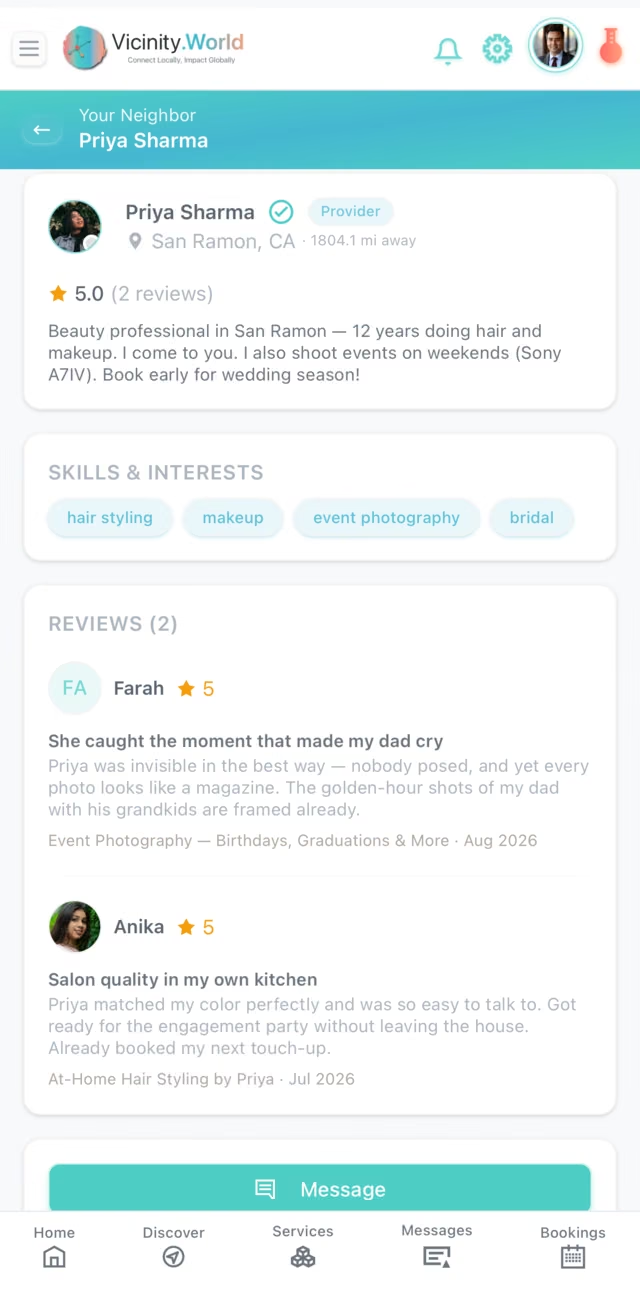
You choose who you work with
Providers see each request and decide whether to offer; requesters pick whom to confirm. Neighbors book a specific person, and providers accept or decline every booking — nothing is assigned automatically.
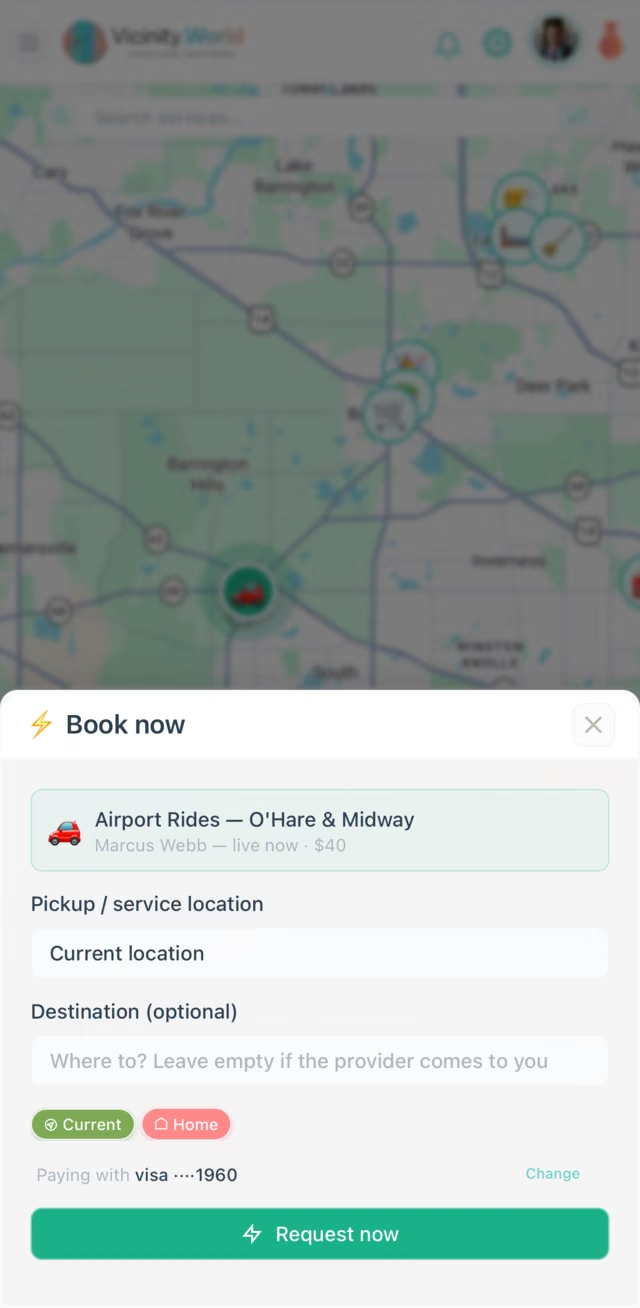
Book now or schedule ahead
Book instantly when a provider is live, or schedule up to three months ahead within their weekly hours — which you can see before you ask.
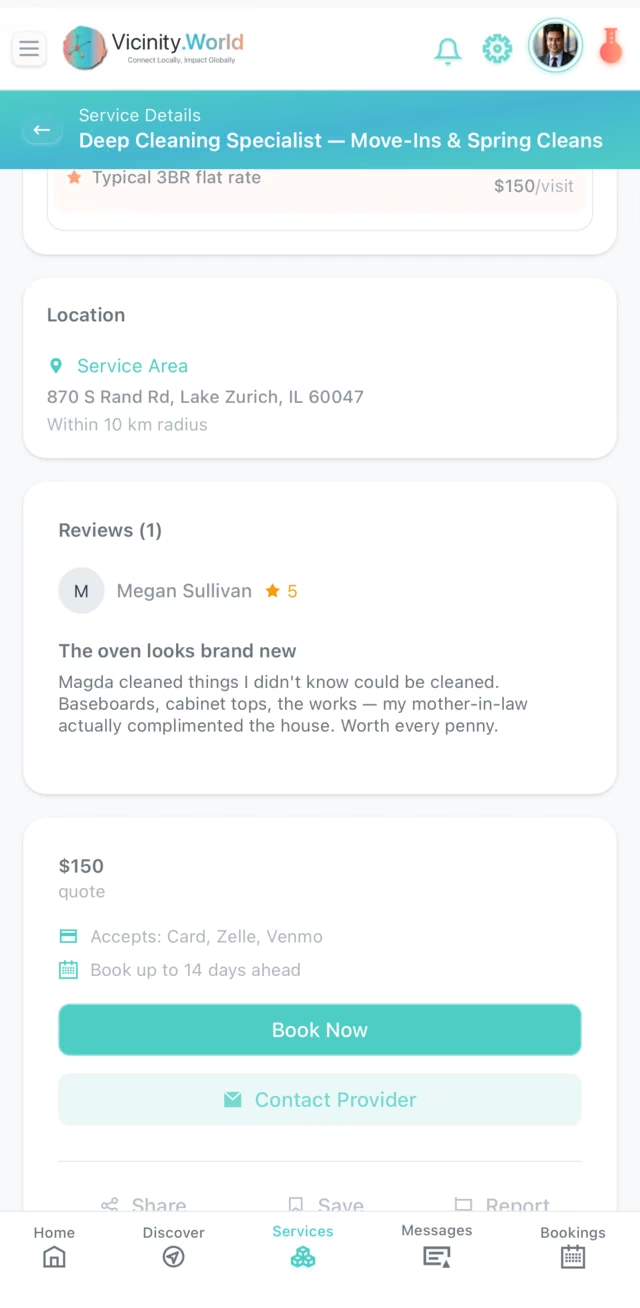
Know where you’re going
Listings show the location the provider sets, on the map, before you book — a stay included. With the fee capped at $20 a month, there is little reason to book around the app, so no reason to hide it.
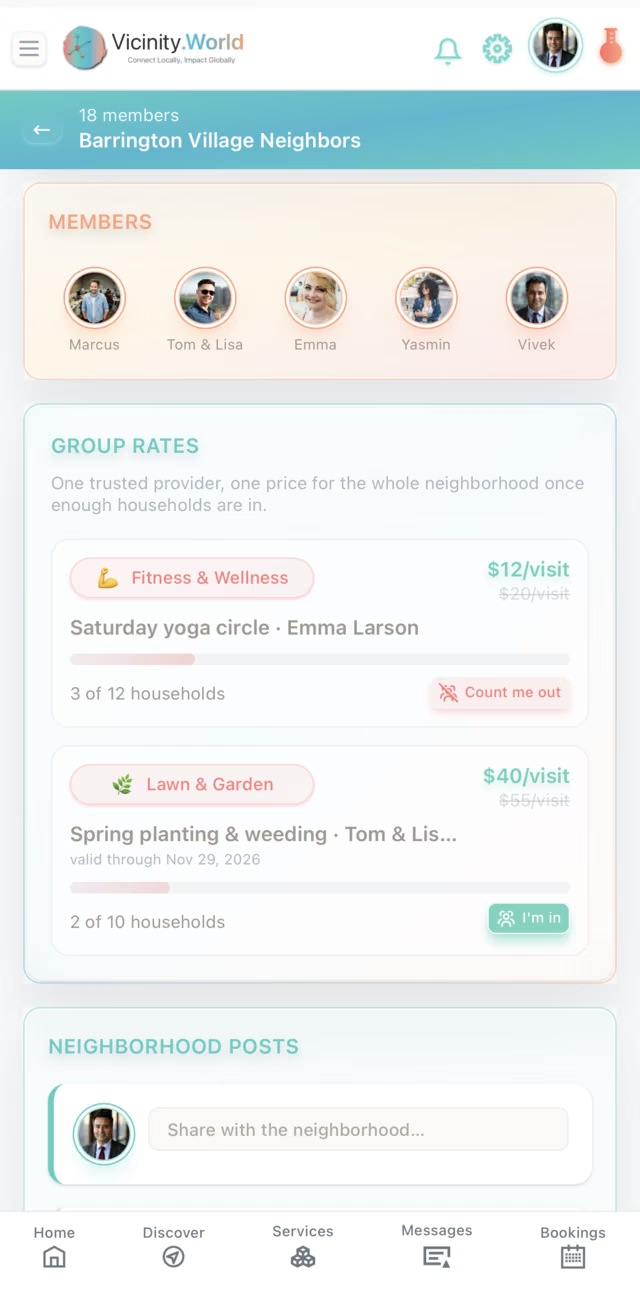
Neighborhood group rates (preview)
A neighborhood sees rates offered to its households together and says it is in. Booking at the group rate is next.
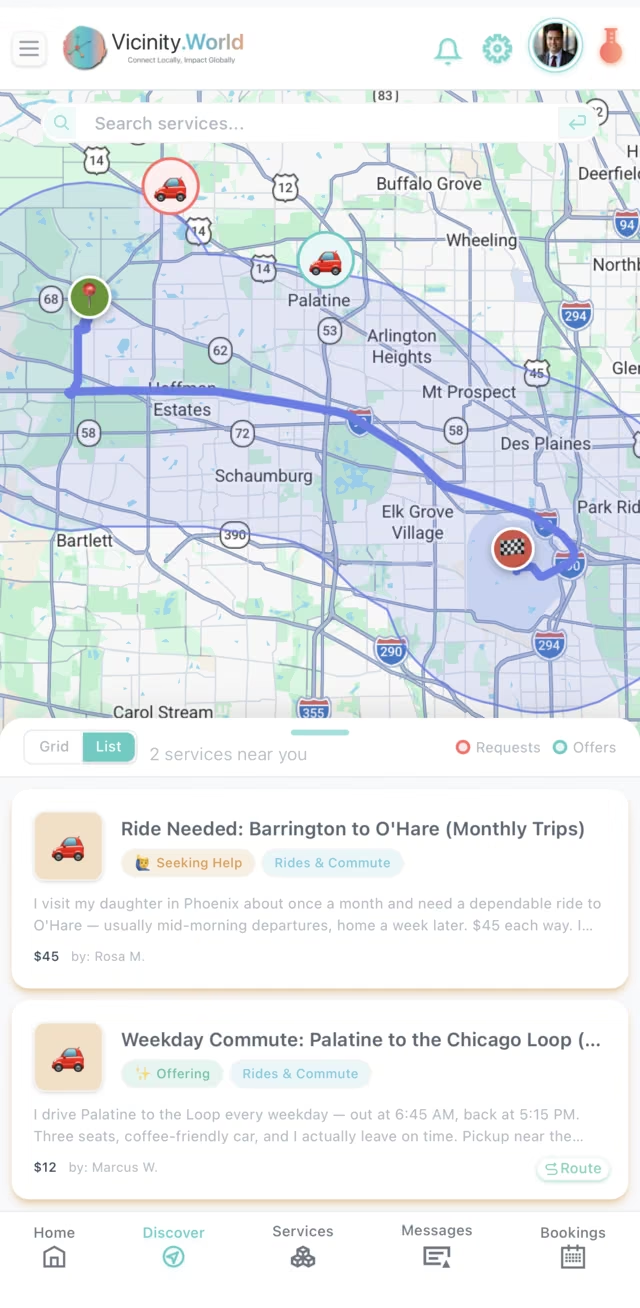
Rides along your way
Find rides near the route you drive, or matching your pickup and drop-off. Save your regular routes.
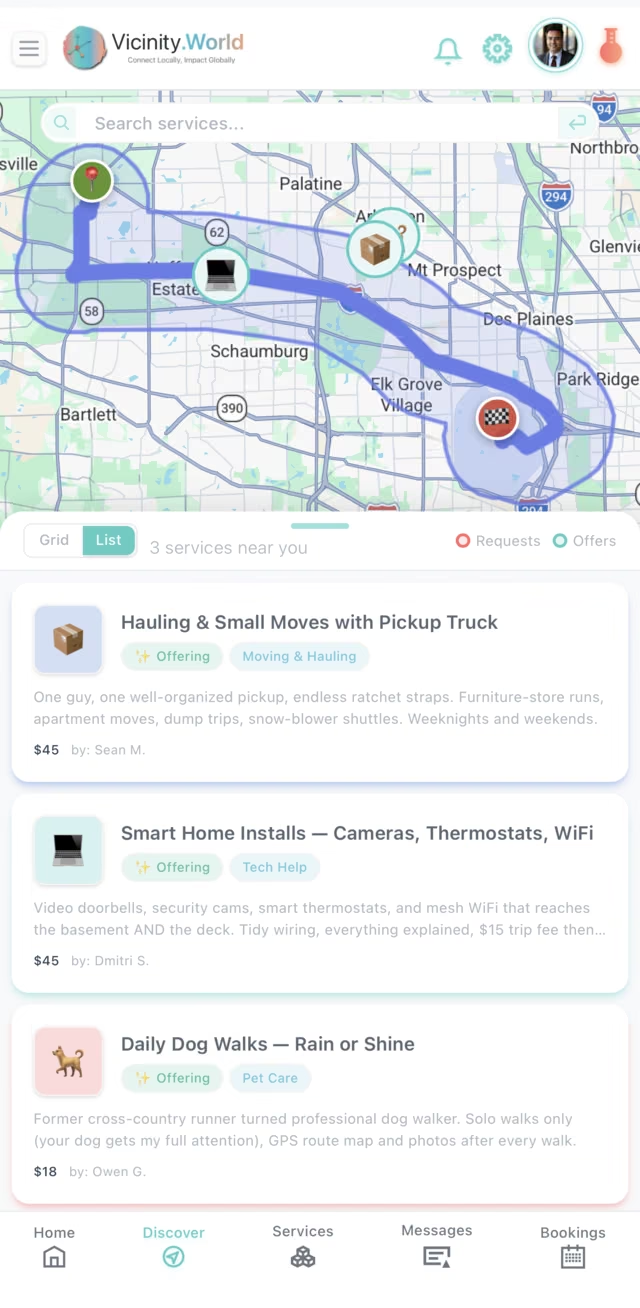
Search the map your way
Draw a circle, rectangle, shape or line on the map, or search along a route, across all 18 categories.
And the everyday parts
One map of people nearby
See what is available around you, or around a place you care about, before you search for anything.
Live map while you wait
While the app is open, both people see the status and the arrival on the same map.
Paid on completion
Providers are paid only when the work is marked complete — and a card is charged only then.
Privacy you set
Visibility by neighborhood, your home address never shown, blocking that is each person’s own choice.
Urgent, and shared
Mark a request or an offer as urgent. Lend, borrow, swap and sell nearby in Tools Exchange and Buy, Sell & Share.
One account everywhere
Web, iPhone and Android with the same account. Pay in the app, or by Zelle, Venmo or cash.
Verified providers
Nobody offers a service before verifying their identity with a photo ID and a live selfie that has to match it.
Anywhere in the US
The app works across the United States. The network is new, so some areas have more providers than others.
Reasons to switch
Is it worth moving?
The two sections above come down to two things: more of the money stays with the people doing the work, and both sides choose who they work with.

If you offer a service
Keep more of each job: 5%, at most $20 a month, against the 15–30% or more common elsewhere.
Choose your work: see each request before you offer, accept or decline each booking, set your own weekly hours.
Try it alongside your current work: 90 fee-free days, no exclusivity, nothing owed in a month with no bookings.
Bring your regular clients: they book you in the app — schedule, payment, reviews — for at most $20 a month.
The same rules and the same reach for a one-person operation as for anyone else.
If you book a neighbor
No fee on your side: the price you agree is the price you pay.
Choose the person: book someone specific, and see their reviews and their hours first.
Every provider has verified their identity before offering a service.
See where you are going before you book, a stay included.
Pay by card and you are charged only when the work is marked complete.
Your address and your data are not for sale; you choose who can see you.

What to expect
The network is new. In many areas there are few providers today — the trade-off of growing by recommendation rather than by advertising. Each provider who joins makes the map more useful for the next neighbor, and each neighbor who books makes it worth a provider’s time. If you want the largest selection today, an established platform may suit you better for now.
The platform is also run by a very small team. That keeps the fee low, and it means some requests take longer than they would at a large company.
Try it free.
Browse as a guest, watch the demo, or list a service with 90 fee-free days.